“Legal, But Deadly”: Rassie On How The All Blacks’ Sneaky Tackle Tactic Humiliated Them

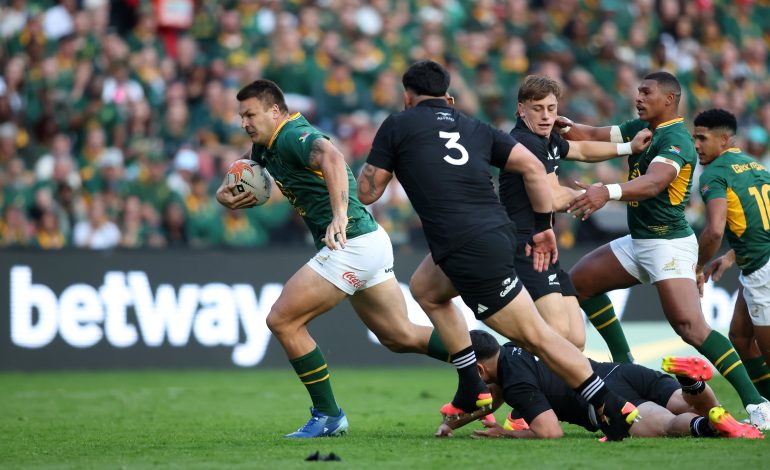
The Springboks were left to rue a costly combination of handling errors and missed opportunities as New Zealand produced a clinical display to secure a statement victory at Ellis Park on Saturday, taking a commanding lead in the Greatest Rivalry Series.
Despite enjoying significant territorial dominance and repeatedly threatening the All Blacks’ defensive line, the Springboks failed to convert their pressure into points. South Africa entered New Zealand’s 22-metre area 11 times but averaged just 0.9 points per entry.
By contrast, the All Blacks entered the Springboks’ 22 nine times and averaged an impressive 3.6 points per visit, ultimately crossing for five tries to underline the ruthless efficiency that proved decisive in Johannesburg.
For captain Pieter-Steph du Toit, the number of handling errors was a major source of frustration, particularly when South Africa were in promising attacking positions.
“I think we made a few critical mistakes, especially in the 22, and some of them were handling errors. It’s something we have to fix for next weekend,” said Du Toit.

South Africa conceded 23 turnovers during the match, with the All Blacks’ defensive pressure and ability to disrupt possession proving to be key factors.
Head coach Rassie Erasmus explained that New Zealand had employed a different defensive approach to the one the Springboks had anticipated, particularly at the tackle.
“They had a very clever tactic where they were stripping in the tackle, which is 100% legal,” Erasmus said.
“They didn’t tackle as we thought they would and as we practised. They were normally either pushing down or performing chop tackles, and in this game they had a lot of strips.”
One significant example came moments before half-time when the Springboks appeared certain to score.
With South Africa asserting their territorial dominance and piling pressure on the All Blacks’ defensive line, World Player of the Year Malcolm Marx powered towards the whitewash and looked destined to score.
However, Jordie Barrett produced a sublime defensive intervention, stripping the ball from Marx at the crucial moment and denying what appeared to be a certain try.
It was one of several outstanding defensive contributions from Barrett, who topped the tackle count for both teams with 15 tackles.
Erasmus acknowledged that New Zealand’s defensive execution was a significant factor in South Africa’s inability to capitalise on their opportunities.
“Even the try, or the non-try, where we mauled the ball, was stripped right over the touchline. So a lot of them are because of the good work that New Zealand did.”
The Springbok coach also dismissed the possibility that the handling errors could be attributed to difficult conditions.
“The ball wasn’t slippery, so we can’t use that as an excuse. We’re not an inexperienced team that played, and it’s probably the pressure that they put on us at those different loose-play breakdowns,” Erasmus added.
“So yeah, we didn’t do well there, and they did great.”
The wastefulness was particularly damaging given the Springboks’ dominance in the opening half. South Africa repeatedly breached the All Blacks’ defensive line but went into the interval with only a one-point advantage.
Asked how frustrating it was to have so little to show for their numerous entries into the New Zealand 22, Erasmus pointed to the visitors’ ability to frustrate opposition attacks close to their own line.
“Yeah, it is disappointing, and that’s probably the thing which New Zealand are great at,” he said.
“They really know how to stop you when you’re inside their 22 in different ways: be it stripping the ball, contesting for the ball on the ground, or harassing the scrum-half within the laws.”
Erasmus stressed that he was not suggesting New Zealand had stepped outside the laws, but rather that the Springboks had struggled to deal with the defensive pressure being applied to them.
“I’m not saying they’re doing it outside the laws and we couldn’t handle that. I don’t want to be quoted the wrong way,” he said.
“I thought up until minute 50, we were really dominating territory and possession, and we felt we were really in the game. But with a class team like New Zealand, if you don’t convert, they give you a proper hiding.”
Ultimately, that proved to be the defining lesson from a bruising evening at Ellis Park.
The Springboks had the territory, possession and opportunities to make the All Blacks uncomfortable, but New Zealand’s ability to force turnovers, defend their line and punish mistakes ensured that South Africa paid the ultimate price for their profligacy.
With another Test against their fiercest rivals next weekend, the Springboks will know that their attacking execution and ball security must improve dramatically if they are to turn pressure into points and avoid another costly lesson from the All Blacks.