Kiwi Coup: The Real Reason Brown Is Swapping Springbok Green For All Black

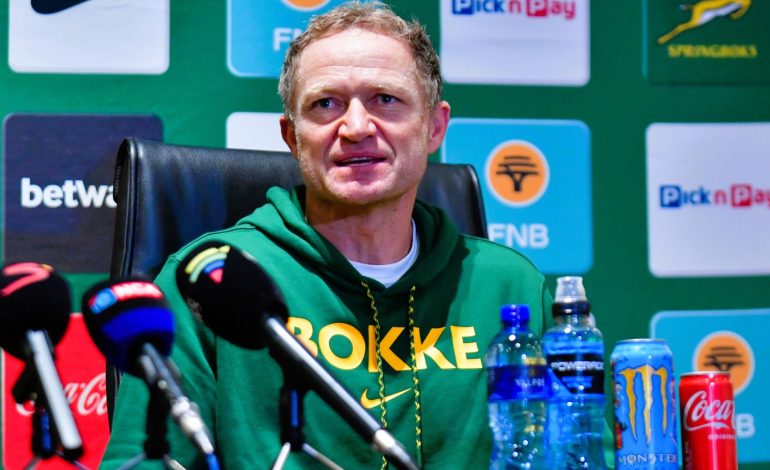
The All Blacks’ announcement that Tony Brown will return home as an assistant coach after the 2027 Rugby World Cup is more than just a coaching appointment — it is a statement of intent.
For South African rugby supporters, the news comes with mixed emotions. Brown has become an integral part of the Springboks’ coaching setup since joining in 2024, helping drive the evolution of their attack while contributing to back-to-back Rugby Championship titles and continued success against the world’s elite sides.
His eventual departure will represent the loss of one of the game’s most innovative rugby minds.
Yet from New Zealand’s perspective, the move makes perfect sense.
Brown’s future became a major talking point when the All Blacks parted ways with Scott Robertson earlier this year. With New Zealand Rugby searching for a new direction, speculation quickly linked Brown to a future role, particularly given his long-standing partnership with Jamie Joseph, who was among the favourites for the vacant position.

The pair’s coaching relationship is built on proven success. Together, they guided the Highlanders to a historic Super Rugby title in 2015 before embarking on a highly successful stint with Japan, where Joseph served as head coach and Brown masterminded the attack. Their understanding of one another’s philosophies has been evident wherever they have worked.
That history makes the next question inevitable: is Brown’s appointment simply the first piece of a larger puzzle?
With Dave Rennie confirmed as All Blacks head coach through to the 2027 Rugby World Cup, New Zealand Rugby has bought itself time. But should Rennie step aside after Australia 2027, many will wonder whether Joseph could emerge as the preferred successor, reuniting one of rugby’s most respected coaching partnerships on the international stage.
The timing of the announcement is also difficult to ignore.
With the Springboks and All Blacks preparing to renew hostilities in the latest chapter of rugby’s greatest rivalry, news that one of South Africa’s key architects is already committed to New Zealand’s future inevitably adds another layer of intrigue.
While there is nothing unusual about securing a coach well in advance, the optics are fascinating.
What the announcement ultimately highlights is just how highly Brown is regarded across the rugby world.
Reports suggest South Africa was eager to extend his stay beyond 2027, potentially keeping him involved through to the 2031 Rugby World Cup in the United States. This follows Springbok head coach Rassie Erasmus extending his own contract with SA Rugby until 2031.
The fact that New Zealand Rugby moved early to secure Brown’s services speaks volumes about his standing in the game and its determination to bring elite Kiwi coaching talent back home.
As New Zealand Rugby CEO Steve Lancaster made clear, this was a straightforward decision in their eyes. When a world-class coach with All Blacks ambitions becomes available, you make your move.
Brown’s decision could easily have become a distraction for the Springboks. Instead, it highlights the professionalism and transparency that have defined his tenure in South Africa.
Perhaps most importantly, Brown’s move appears to be driven by personal reasons rather than professional dissatisfaction. His desire to return home, be closer to his family, and contribute to New Zealand Rugby has never been hidden, and both SA Rugby and Erasmus have acknowledged that honesty throughout the process.
“We are grateful to Tony for his commitment, loyalty, and honesty throughout his time with us,” said SA Rugby CEO Rian Oberholzer.
“He has made a tremendous contribution to the Springboks and to SA Rugby as a whole since joining us, and we have no doubt that he will continue to give everything he has to help the team maintain the high standards we set for ourselves on the field.”
Erasmus was equally pleased for Brown.
“Tony has made a remarkable difference, both on and off the field, and he has always been upfront with us about wanting to be closer to his family and about the All Blacks holding a special place in his heart. We are genuinely delighted for him,” said Erasmus.
For the Springboks, there is still plenty of time to maximise Brown’s influence before he departs. South Africa will undoubtedly remain focused on what lies ahead rather than what comes after.
But make no mistake: this is a significant coup for New Zealand Rugby.
Brown has expressed his gratitude to Erasmus and SA Rugby and reiterated his full commitment to the team’s ambitions over the next two seasons.
“My contract with New Zealand Rugby only begins in 2028, so there is still a long road ahead before that comes into play,” said Brown.
“Right now, I am fully committed to the Springboks. What we are building and trying to achieve as a team over the next two years is my only focus.”
The All Blacks have not just secured an assistant coach. They have secured one of the architects behind the Springboks’ recent evolution — a coach who has helped sharpen the attack of the world’s most successful team of the modern era.
And when 2028 arrives, he will be applying those lessons in black rather than green and gold.